
NIOSH Lifting Equation - Horizontal Distance Multiplier Factor
On this page
How can the horizontal distance affect the weight limit?
Back to topExample: A worker lifts 15 kg boxes from the table to the shelf five times an hour. Notice that there is a barrier between the worker and the box.
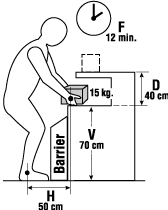
To calculate the recommended weight limit (RWL) for the task:
- Determine the weight of the load.
Weight equals 15 kg
- Assess the six components of the lifting task. Refer to Assessing Relevant Handling Factors for an explanation of the terms.
H (Horizontal Distance) - 50 cm
V (Vertical Distance) - 70 cm
D (Lifting/Carrying Distance) - 40 cm
F (Frequency) - 12 min
A (Angle) - 0°
C (Coupling/quality of grip) - fair
- Select the multiplier factors for each component of the lifting from the tables in Calculating Recommended Weight Limit (RWL).
- Determine the Recommended Weight Limit for the task. Refer to Assessing Relevant Handling Factors and Calculating Recommended Weight Limit (RWL).
The revised NIOSH Lifting Equation is: 23 Kg x HM x VM x DM x AM x FM x CM= RWL
23 Kg x 0.50 x 0.99 x 0.93 x 1.00 x 1.00 x 1.00 = 10.59 kg
- Compare the weight of the load against determined Recommended Weight Limit for the task:
The recommended weight is 10.59 kg, which is less than the current weight at 15 kg.
Conclusion
The weight of the load is 15 kg, which is higher than the calculated recommended weight limit of 10.59 kg.
Therefore, this task is likely to increase the risk of a lifting related injury.
Recommendations
- Assess which components of the task contribute most to the risk. Refer to Assessing Relevant Handling Factors
The critical component is H, the horizontal distance of the box from worker's body.
- Remove the barrier to allow worker to get closer to the box (horizontal distance is now 30 cm which uses a factor of 0.83).
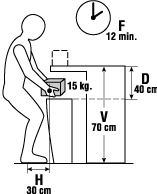
Evaluate the Redesigned Task
- Assess the six components of the task in redesigned layout.
- Determine the new Recommended Weight Limit for the task. Refer to Assessing Relevant Handling Factors and Calculating Recommended Weight Limit (RWL).
The revised NIOSH Lifting Equation is: 23 kg x HM x VM x DM x AM x FM x CM = RWL
23 kg x 0.83 x 0.99 x 0.93 x 1.00 x 1.00 x 1.00 = 17.58 kg
- Compare weight of the load against Weight Limit in new layout.
The weight of the load at 15 kg is now lower than the recommended weight limit of 17.58 kg.
Therefore, MOST WORKERS CAN SAFELY PERFORM THE TASK.
- Fact sheet last revised: 2021-05-27