
Pushing and Pulling - Handcarts
On this page
Are there hazards associated with using hand carts?
Back to topThe use of hand carts to transport loads instead of carrying them saves workers a lot of effort. It decreases the risk of overexertion injury in jobs that include manual materials handling.
However, pushing, pulling, and maneuvering hand carts still involve some common hazards (overexertion). The most common injuries that result from hand cart operations are:
- fingers and hands being caught in, on, or between the cart and other objects,
- toes, feet and lower legs being bumped or crushed by the cart,
- slips, trips, and falls, and
- strain injuries predominantly for the lower back, shoulder, and arm muscles and joints.
Also see the OSH Answers on Pushing and Pulling – General for more information.
What characteristics affect how much weight can be safely transported on a hand cart?
Back to topOverall, it is the combined weight of the cart and load that must be considered. However, it is difficult to outline how much weight can be transported using a hand cart. Many factors affect how much force is needed to move a given weight. The main factors are:
1. Workplace Characteristics:
a. Aisle width - aisles should be wide enough for the operator's body to safely stand behind the cart at all times and apply the force necessary to move it. Load weight may need to be reduced in tight aisles or corners.
b. Ramps - more force is required to move the same weight up ramps, as well as to slow down a fully loaded cart while moving down ramps.
c. Floor characteristics - damaged, uneven, or etched floors create hazards in that they can catch wheels or castors in them. Floors that are dusty, dirty, oily, or wet will reduce the ability of the handler to maintain traction. Without friction, the worker will need to exert excessive force to move the load, and may slip and trip.
2. Cart Characteristics:
a. wheel/castor size and number of wheels or castors
b. handle orientation/height, handle diameter
c. overall cart size
d. weight of the cart
e. stability of cart
3. Task:
a. The force needed for the initial movement – recommendations include a pushing or pulling force of no more than 320 N for males, and 220 N for females (N = Newtons, where 10 newtons is approximately 1 kg).
b. The force needed to sustain motion - recommendations include a pushing or pulling force of no more than 230 N for males, and 130 N for females (N = Newtons, where 10 newtons is approximately 1 kg).
c. The distance and duration the load is moved (e.g., how far and how long).
d. Direction and nature of movement.
4. Operator knowledge and training: training in how to move the cart safely can lower some forces on the body.
5. Human Factors:
a. Height
b. Weight
c. Age
d. Strength
e. Gender
f. Posture
g. Physiological capacity
How much weight can be safely transported on different types of hand carts?
Back to topGood design of the workplace and the selection of a hand cart suitable for the task can reduce the risk of injury. Points to consider when selecting carts include:
- expected load (weight, size, shape),
- frequency of use,
- distances to cover,
- work area characteristics (aisle width, type of flooring), and
- type of wheels or casters.
There are currently few numerical standards on acceptable loads or forces required while operating hand carts. Recommendations presented in Table 1 are adopted from guidelines developed by the Ergonomics Group of Eastman Kodak Co. who compiled data from various studies.
General recommendations for selection are:
- the load on three-, and four- wheel hand carts should not exceed 200 Kg (approximately 450 lbs),
- the load on hand pallet carts can be up to approximately 700 Kg (1500 lbs),
- manual carts should not be used more than 200 times a work day,
- the load should not be transported more than 30-35 meters (about 100 feet) per "shipment".
Where there is a need to move heavier loads over longer distances, using powered trucks or a powered conveyor system should be considered. Also note that pushing and pulling under non-ideal conditions lowers the safe pushing and pulling limit.
| Table 1 Recommended Limits in the Selection of Hand and Powered Trucks and Carts |
||||||||
|---|---|---|---|---|---|---|---|---|
| Type of Truck or Cart | Maximum Load | Maximum Transport Distance | Maximum Frequency Units (per 8 hr - shift) |
Minimum Aisle Width | Type of Transfer to and from Truck+ | |||
| kg | lb | m | ft | m | ft | |||
| 2-wheeled hand cart | 114 | 250 | 16 | 50 | 200 | 1.0 | 3 | Ma, P |
| 3-wheeled hand cart | 227 | 500 | 16 | 50 | 200 | 1.0 | 3 | Ma, P |
| 4-wheeled hand cart | 227 | 500 | 33 | 100 | 200 | 1.3 | 4 | Ma, P |
| Hand pallet truck | 682 | 1500 | 33 | 100 | 200 | 1.3 | 4 | Me, UL |
| Electric pallet truck | 2273 | 5000 | 82 | 250 | 400 | 1.3 | 4 | Me, UL |
| Electric hand-jack lift truck | 2273 | 5000 | 33 | 100 | 400 | 1.3 | 4 | Me, UL |
| Power low lift truck | 2273 | 5000 | 328 | 1000 | 400 | 2.0 | 6 | Me, P, UL |
| Electric handstacking truck | 682 | 1500 | 82 | 250 | 400 | 1.3 | 4++ | Me, UL |
| Power fork truck | 2273 | 5000 | 164 | 500 | 400 | 2.0 | 6++ | Me, UL |
+ Ma = Manual; Me = Mechanical; P = Parts; UL = Unit Load
++ These trucks have tiering capability. In order to use it, ceiling must be more than 4 m (12 ft) high.
Adapted from: Ergonomic Design for People at Work: Vol. 2, by Eastman Kodak Company. Van Nostrand Reinhold, 1986, and Kodak’s Ergonomic Design for People at Work 2nd edition by Somadeepti, et al. 2004.
How can I reduce the risk of using hand carts in my workplace?
Back to topEliminate pushing and pulling of loads where possible. For example, consider installing conveyor systems, even for short distances.
Modifying force limits for pushing, pulling or maneuvering for any given work situation is essential not only for the safety of the operator but also for other workers within the work area.
Simple actions can be taken to ensure the risks associated with using hand carts are minimized:
1. Workplace characteristics:
a. Aisle Conditions:
i. Keep aisles clear of clutter.
ii. Aisles should be wide enough to allow the worker to stand behind the cart and push.
iii. Corners should accommodate the turning radius of the moving cart without stopping and starting.
b. Ramps:
i. Use winches for large ramps.
ii. Use power assists (a battery powered pushing device).
iii. If multiple ramps are present, include a hand or foot brake on the cart to help the operator control heavy loads.
iv. If multiple ramps are present, consider using powered carts.
c. Floor Conditions:
i. Keep floors in good repair.
ii. Ensure floors are clean, free of debris, dirt, dust, miscellaneous liquids, or spills.
iii. If floors are very uneven, consider fixing the floors or using powered carts.
2. Cart Characteristics:
a. Wheels/Castors:
i. Use a larger diameter wheel. Increasing the diameter of the wheels generally decreases force requirements.
ii. A harder caster/tire generally decreases force requirements.
iii. A wider tread generally increases force requirements.
Note: Pneumatic wheels should not be used for heavy loads as they may compress and substantially increase the force requirements.
b. Handles
i. Use swivel castors on the same end of the cart as the handle (Figure 1).
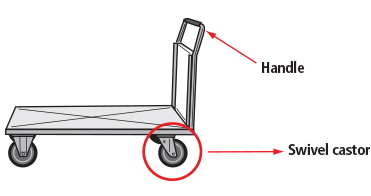
Figure 1
ii. Handles on pallet trucks should be long enough to prevent worker's feet from being struck by body of pallet truck (Figure 2).
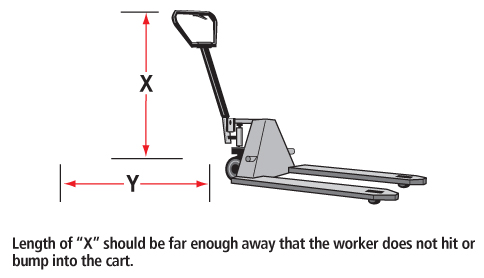
Figure 2
iii. Fixed horizontal handles should be at a height between 91 cm and 112 cm above the floor (Figure 3).
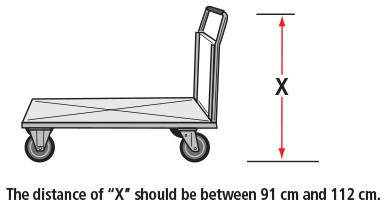
Figure 3
iv. Vertical handles allow a worker to place hands at comfortable positions for their height (usually used for tall or narrow carts) (Figure 4).
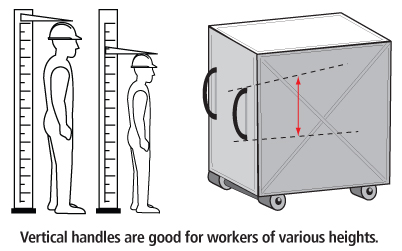
Figure 4
v. For handles fixed to the cart's surface, the handles should not be more than 46 cm apart. Wider separations increase the load on smaller shoulder muscles.
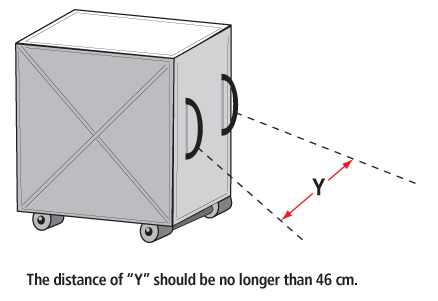
Figure 5
vi. Handles should be thick enough to grip easily - 2.5 cm to 3.8 cm.
vii. Fixed handles mounted in the horizontal direction should have a minimum length of 20 cm.
c. Cart size
i. Large carts (longer than 1.3 m and/or wider than 1 m) are difficult to maneuver and should not be used in workplaces with narrow aisles.
3. Task:
a. Risk factors include high pace of work, heavy loads, high exertion, repetition of movements, high force used, long distances, poor flooring, poor path for the cart to travel, and poor footing (grip of footwear to the floor). Design the work flow and work pace to minimize these factors.
4. Operator Training/Experience:
a. Operators should be trained on appropriate body positioning for the type of cart and load being handled.
b. Operators should receive training on how to maneuver heavy loads.
c. Operators should walk at an appropriate cart speed - recommended speeds should match a typical walking pace (3-4 km/h).
d. Operators should opt to push rather than pull carts wherever possible. Tasks should be designed so that the operator can push the load.
5. Human Factors:
a. Design the work pace and work flow to suit as many individuals as possible. Allow operators some control over the work they do.
b. Choose equipment that will suit or be adjusted to as many individuals as possible.
c. Use appropriate footwear for the flooring. Soles that slip will increase the effort needed to move the cart.
- Fact sheet last revised: 2018-03-01