
Work-related Musculoskeletal Disorders (WMSDs) - Risk Factors
On this page
- What are the risk factors for work-related musculoskeletal disorders (WMSDs)?
- How are work postures and movements a risk for WMSDs?
- How does repetitiveness and pace of work influence WMSDs?
- What should I know about force of movements?
- How does vibration encourage WMSDs?
- How does temperature affect WMSDs?
What are the risk factors for work-related musculoskeletal disorders (WMSDs)?
Back to topWork-related musculoskeletal disorders (WMSDs) are associated with these factors:
- Work postures and movements.
- Repetitiveness and pace of work.
- Force of movements.
- Vibration.
- Temperature.
- Lack of influence or control over one's job.
- Increase pressure (e.g., to produce more).
- Lack of or poor communication.
- Monotonous tasks.
- Perception of low support (e.g., manager or co-worker).
Certain workplace conditions, for example, the layout of the workstation, the speed of work (especially in conveyor-driven jobs), and the weight of the objects being handled influence these factors. In other situations, the psychosocial factors at the workplace may contribute to WMSDs. It is recommended that both physical and psychosocial factors be addressed.
For more information about WMSDs in general, please see our OSH Answers document Work-related Musculoskeletal Disorders (WMSDs).
How are work postures and movements a risk for WMSDs?
Back to topAny body position can cause discomfort and fatigue if it is maintained for long periods of time. Standing, for example, is a natural body posture, and by itself poses no particular health hazards. However, working for long periods in a standing position can cause sore feet, general muscular fatigue, and low back pain. In addition, improper layout of work areas, and certain tasks can make workers use unnatural standing positions.
Two aspects of body position can contribute to injuries. The first relates to body position. When parts of the body are near the extremes of their range of movements, stretching and compression of tendons and nerves occur. The longer a fixed or awkward body position is used, the more likely we are to develop WMSDs. For example, working with the torso bent forward (Figure 1), backward or twisted can place too much stress on the low back. Other examples of stressful body positions include reaching above shoulder level (Figure 2), reaching behind the body (Figure 3), rotating the arms (Figure 4), bending the wrist forward, backward, or side to side (Figure 5), and reaching forward too far out in front of the body (Figure 6).
The second aspect that contributes to WMSDs is holding the neck and the shoulders in a fixed position. To perform any controlled movement with the arm, muscles in the shoulder and the neck contract and stay contracted for as long as the task requires.
The contracted muscles squeeze the blood vessels, which restricts the flow of blood all the way down to the working muscles of the hand.
However, this is where the blood is needed the most because of the intense muscular effort. Two things happen as a result. The neck/shoulder muscles become overtired even though there is little or no movement. At the same time, the reduced blood supply to the rest of the arm accelerates fatigue in the muscles that are moving, making them more prone to injury.
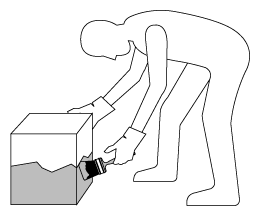
Figure 1 - Bending forward
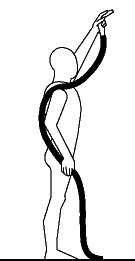
Figure 2 - Reaching above shoulder level
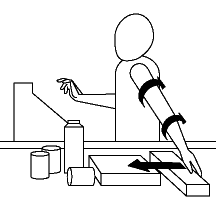
Figure 3 - Reaching behind the body
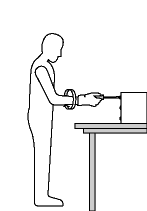
Figure 4 - Rotating the arms
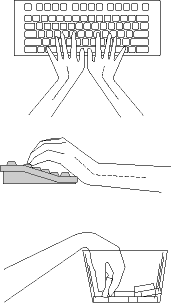
Figure 5 - Bending the wrist
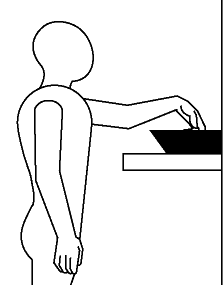
Figure 6 - Reaching forward
How does repetitiveness and pace of work influence WMSDs?
Back to topRepetitive movements are especially hazardous when they involve the same joints and muscle groups over and over and when we do the same motion too often, too quickly and for too long. Tasks requiring repetitive movements always involve other risk factors for WMSD such as fixed body position and force; the worker, in order to perform the task, has to maintain the shoulder and neck in a fixed position to exert some force.
To analyze how repetitive a task is, we need to describe it in terms of steps or cycles. For example, the bottle packing operation (Figure 7) requires workers to pack boxes with twenty-four bottles.
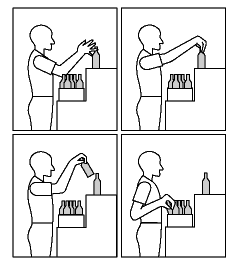
Figure 7 - Packing bottles
One cycle can be described as follows:
- Reach for bottles.
- Grasp bottles.
- Move bottles to box.
- Place bottles in box.
If a worker grasps four bottles each time, the same cycle would have to be repeated six times to fill a box. Assuming that one cycle lasts two seconds, it would take twelve seconds to pack a box with twenty-four bottles.
There are no rules to judge movements as either high or low in repetition. Some researchers classify a job as "high repetitive" if the time to complete such a job was less than 30 seconds or "low repetitive" if the time to complete the job was more than 30 seconds. Although no one really knows at what point WMSDs may develop, workers performing repetitive tasks are at risk for WMSDs
Work involving movement repeated over and over is very tiring because the worker cannot fully recover in the short periods of time between movements. Eventually, it takes more effort to perform the same repetitive movements. When the work activity continues in spite of the fatigue, injuries can occur.
Pace of work determines the amount of time available for rest and recovery of the body between cycles of a particular task. The faster the pace, the less time is available and the higher the risk for WMSD.
When the worker has no control over timing and speed of work because of external factors like assembly line speed or quota systems then stress level increases. With higher stress level comes muscle tension causing fatigue and again increased risk for WMSD. Controlling the pace of work externally denies the worker the flexibility to determine their own work speed. It is a human characteristic to work at varying rates at different times of the day.
What should I know about force of movements?
Back to topForce is the amount of effort our bodies must do to lift objects, to use tools, or to move.
More force equals more muscular effort, and consequently, a longer time is needed to recover between tasks. Since in repetitive work, as a rule, there is not sufficient time for recovery, the more forceful movements develop fatigue much faster. Exerting force in certain hand positions is particularly hazardous (Figures 8A-8F).
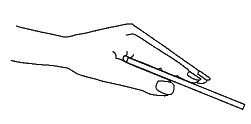
Figure 8A - Pulp pinch
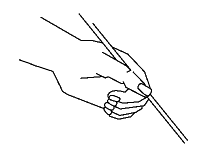
Figure 8B - Lateral pinch
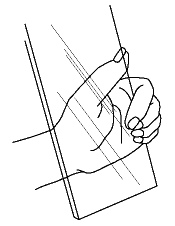
Figure 8C - Palm Pinch
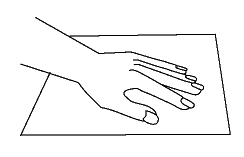
Figure 8D - Finger Press
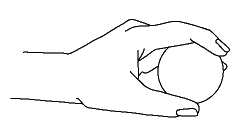
Figure 8E - Pulp grasp
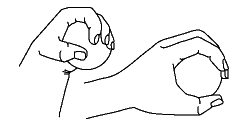
Figure 8F - Finger press
The amount of force we use to do a job depends on many factors such as the weight of the objects and their placement in relation to the body. It requires more force to lift and carry a box with arms outstretched and held away from the body (Figure 9A) or to lift the same objects in a "pinch" position (Figure 9B) than in a "hook" position (Figures 10A, 10B).
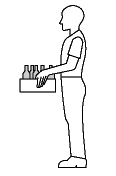
Figure 9A - Lifting in a "pinch"
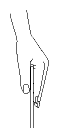
Figure 9B - Pinch position
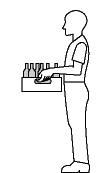
Figure 10A - Lifting in a "hook"

Figure 10B - Hook position
The shape of the tool plays an important role, also. Tools that do not allow the best position of the wrist, elbow and shoulder substantially increase the force required. Worn and poorly maintained tools are very important as well, yet often overlooked. For example, a worn screwdriver, pliers with worn jaws, or dull scissors can increase the operating force as much as tenfold.
Although no one really knows when WMSDs will develop, workers performing forceful movements are at risk. Work involving forceful movements is very tiring again because there is not time for a full recovery between movements. Eventually it takes effort to perform the same task. When the work activity continues in spite of the developing fatigue, injuries occur.
How does vibration encourage WMSDs?
Back to topVibration affects tendons, muscles, joints and nerves. Workers can be exposed to either whole body vibration or localized vibration.
Whole body vibration is experienced by truck and bus drivers for example. Localized vibration exposure can be caused by power tools. Common symptoms are numbness of the fingers, loss of touch and grip, and pain. In addition, the worker may use more force and awkward body positions because vibration hand tools are harder to control.
Exposure to too much vibration can also cause us to lose the feeling in our hands and arms. As a result, we may misjudge the amount of force we need to control the tools and use too much which increases fatigue.
How does temperature affect WMSDs?
Back to topIn general, when it is too cold, or when we touch cold materials, our hands can become numb. With numbed hands, we are more likely to misjudge the amount of force we need to do our work and use too much. A cold environment also makes our bodies less flexible. Every movement we make and every position we hold takes a lot more work, and then WMSDs are more likely to develop.
When it is too hot and too humid, workers tire more quickly and thereby may become more susceptible to injury.
- Fact sheet confirmed current: 2019-09-12
- Fact sheet last revised: 2014-01-08