
Working in a Sitting Position - Basic Requirements
On this page
What are the basic requirements for sitting comfort?
Back to topThe basic requirements are to have a workstation and job tasks designed to allow a person to remain in a balanced position or neutral posture, regardless of the work being done. The CSA Standard Z412-17 Office ergonomics – An application standard for workplace ergonomics recommends that alternating between sitting and standing, or variations on sitting and standing postures (e.g., reclining, forward tilting, and semi-standing) are encouraged in order to avoid the negative effects of prolonged sitting or standing in one posture. CSA also states that there is no uniquely correct working posture that fits a user for an extended period of time.
This document covers working in a sitting position. Please see other OSH Answers, including Sit/Stand Desk, Working in a Sitting Position, and Working in a Standing Position, for more information.
Workstation
A workstation should allow the worker to sit in a balanced body position.
- Use a workstation that allows for the alignment of the spine whether the worker sits or stands.
- Use a workstation that allows the worker to move the spine freely.
- Use a workstation that can be adjusted to the needs of the worker.
Job design
A job design should allow the worker to work in a variety of balanced positions.
- Design tasks so they require movement of the spine and encourage the worker to alternate positions frequently.
- Avoid an excessive range of movement by:
- providing all materials at working level
- positioning tasks within easy reach
- avoiding lifting and transferring loads while sitting.
- Avoid static positions.
- Position visual tasks that maintain the vertical alignment of the head and spine
- Design the lighting system to:
- provide good general lighting.
- provide task lighting where necessary.
- avoid glare.
What is meant by a neutral posture, reference posture, or balanced position?
Back to topGravity constantly exerts a downward force on our bodies. Parts of our body in contact with a supporting structure (the seat of chairs, armrests, floors, etc.) will feel pressure from the structure to balance this force. Parts of our bodies that are not in contact with a supporting structure will use muscles, tendons, and ligaments to balance the force of gravity with an upward force of their own.
The body position that has the highest strength to handle the pressure felt by the supporting structure, while causing the least amount of strain on the muscles, tendons, and ligaments, is called the neutral or balanced body position.
The following recommendations outline how to maintain a neutral body position while sitting:
- Soles of the feet making an angle of 90° with the lower legs.
- Thighs approximately in a horizontal position and lower legs vertical with feet resting on the floor or on a foot rest.
- Erect or upright spine.
- No twisting of the upper torso.
- Shoulders are relaxed and upper arms hang normally at the side of the body.
- Elbows stay close to the body and are bent between 90° and 120°.
- Hands, wrists, and forearms are straight, in-line and roughly parallel to the floor.
- Head and neck is upright (not turned, tilted, flexed or extended). Generally it is in-line with the torso.
- Feet are fully supported by the floor, or a footrest may be used if the desk height is not adjustable.
- Back is fully supported with appropriate lumbar support when sitting vertical or leaning back slightly.
- Thighs and hips are supported by a well-padded seat and generally parallel to the floor.
- Knees are about the same height as the hips with the feet slightly forward.
- The in-line sight is between the horizontal and 35° below the horizontal (up and down), and with a 30° range as optimal line-of-sight angle. Vertically (side to side) the optimum viewing is directly in front of you, with 15° to either side. 35° side to side is maximum.
Note: No one seating position can remain comfortable over a long period of time. For this reason, multiple positions in which the body can be in the neutral position are recommended. As mentioned above, the workstation should allow the worker to adjust and move between these positions.
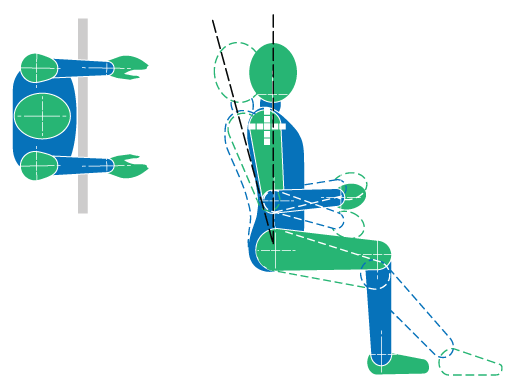
Figure 1
Reference posture for sitting (From CSA Z412-17)
How should manual tasks be designed?
Back to topSeated manual tasks should be designed to maintain vertical alignment of the spine, and avoid constant stress on the shoulder region. This alignment can be done by:
- providing materials at or slightly below elbow height
- Providing arm rests where appropriate
- providing tool balancers and avoid heavy hand tools
- avoiding tasks that require the shoulder or arms to be excessively high (keep below 15 cm above the surface of the work surface)
- avoiding tasks that require excessive reach. Place items according to importance and how often you will use them
- primary zone – immediate reach, for items needed most frequently or of highest importance
- secondary zone – within arm’s reach, for items of lower importance or used occasionally
- tertiary zone – area farthest away which requires you to bend forward to reach, for rarely used items.
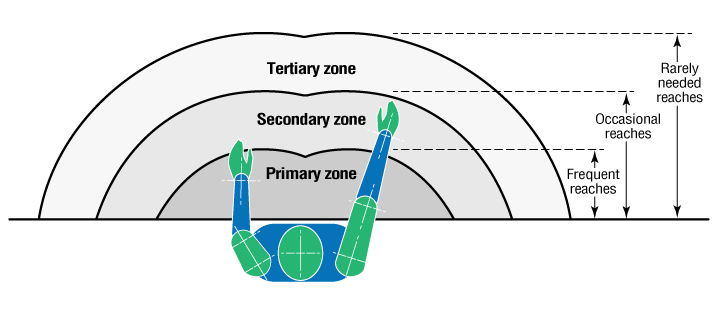
Figure 2
General guidelines for work reaches (From CSA Z412-17)
What should be considered when a foot task is necessary?
Back to top- Position foot tasks so that they can be done without twisting hips.
- Design foot tasks to avoid movement and exertion by only one leg.
- Provide the appropriate support for both working and non-working leg.
- Design a sitting task that encourages the worker to alternate positions frequently.
- Fact sheet last revised: 2018-02-08