
Industrial Ventilation - 2. Units and Measures
On this page
What is covered in this document?
Back to topThis document is part of a series of documents on industrial ventilation.
How is the dilution ventilation rate measured?
Back to topGenerally, the dilution ventilation rate is measured by the number of air changes per hour (ACH).
An air change means the replacement of the entire volume of air in the workspace. The air change rate indicates how many times per hour a room (workplace) needs to have the air totally replaced.
Health and safety legislation, fire codes, building codes, and ventilation design standards usually indicate the air exchange rate required in specific situations. For example, the Quebec Regulation respecting occupational health and safety requires, at minimum, four fresh air changes per hour for garages for maintenance and repairs. The Canadian Standard CSA Z 317.2 "Special requirements for heating, ventilation, and air conditioning (HVAC) systems in health care facilities" sets the minimum outdoor air changes per hour at 6, and the total air changes at 20 changes per hour for operating rooms.
The following formula can be used to determine the air exchange rate:
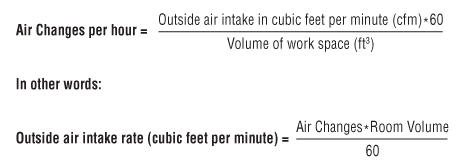
Here is an example:
The volume of air in a room which is 12.5 meters (41 feet) long, 12.5 meters (41 feet) wide, and 4 meters (13.12 feet) height is:
Vroom = 12.5 * 12.5 * 4 = 625 m3 (22072 ft3)
To change this volume of air only once per hour, we need an air rate of:
Air flow rate (m3/h) = Air exchanges * Room Volume = 625 m3/h
Or

The air changes per hour (or minute) may not be an appropriate measure for ventilation criteria when controlling certain hazards, heat, or odours. The ventilation rates should be determined based on several factors, such as the amount of contaminant generated, the toxicity of that contaminant, the nature of the emission (steady or cyclic), and the mixing effectiveness (not just the size of the room).
Are there any design standards available?
Back to topAlthough there are not many specific government codes and regulations, there are many recommended standards. Some are described below (in no particular order):
Please see the OSH Answers document Industrial Ventilation - Glossary of Common Terms for a description of the acronyms.
Ontario Occupational Health and Safety Act - Regulation 851 for Industrial Establishments (sections 127 & 128) mentions general requirements for adequate ventilation and replacement air.
British Columbia OHS Regulation - BC Regulation 296/297 Part 5.60-5.71 gives the detailed requirements for dilution ventilation, Local Exhaust Ventilation (LEV), make-up air, discharged air and recirculation of discharged air.
OSHA - This US Government agency has promulgated a few ventilation standards, e.g., the four standards in 29CFR1910.94 dealing with local exhaust systems. OSHA's construction standards in 29CFR1926 contain ventilation standards for welding. Such ventilation systems are "required," but OSHA usually does not consider its ventilation standards violated unless exposure standards are also violated.
NIOSH - This US Government research organization has published a number of useful ventilation documents, including publications on foundry ventilation, recirculation, and push-pull hoods.
AMCA - This US trade association has developed standards and testing procedures for fans. It has a number of useful publications related to fan selection, testing, troubleshooting and certification (e.g., AMCA 201).
ASHRAE - This US-based society of heating and air conditioning engineers has produced a number of standards related to indoor air quality (IAQ), filter performance and testing comfort, and HVAC systems.
ANSI -This US-based consensus standards-setting organization has produced several important standards on ventilation, including paint spray booths, grinding exhaust hoods, open sun tank exhausts and laboratory ventilation.
ACGIH - The ACGIH Industrial Ventilation Committee publishes the manual of recommended practices for industrial ventilation. The Manual has been recognized worldwide as a useful source of information on all aspects of industrial ventilation systems.
SMACNA - This US association of sheet metal contractors and suppliers sets standards for ducts and duct installation.
NFPA - This US-based fire protection association has produced a number of recommendations (which become requirements when adopted by local fire agencies), e.g. NFPA 45 lists a number of ventilation requirements for Lab Fume hood use.
BUILDING CODES - There are building codes set or adopted by almost every city, county and municipality. All industrial buildings have to be built to these codes in order to have a building accepted. However, most have little direct reference to industrial ventilation, but these codes need to be checked.
- Fact sheet last revised: 2023-07-05