
Forklift Trucks - Maintaining Truck Control
On this page
- How do you maintain control of the load when handling pallets?
- How do you maintain control when lifting, tilting, and stacking a load?
- How do you maintain control when travelling?
- How should you steer to maintain control?
- How do you maintain control when driving in reverse?
- How do you maintain control when travelling up or downhill?
- How should you shut down the forklift truck?
How do you maintain control of the load when handling pallets?
Back to topEnsure that forks are:
- Level.
- High enough to enter the pallet.
- Proper width to provide an even distribution of the weight.
- All the way under the load, reaching up to at least two-thirds of the load length.
How do you maintain control when lifting, tilting, and stacking a load?
Back to top- Before any lift, make sure the forks are properly centred under the load, the forklift is stopped, and the brake is engaged.
- Lift the load straight up until it is clear of the ground, rack, or other materials. Watch that the load does not catch on adjacent loads or obstructions.
- Tilt the load back.
- Slowly reverse straight back (if possible) with the load suspended, continuously checking for obstructions for the load and forklift. Once the load is clear from all obstructions, it can be lowered to a height of about 10-15 cm (4-6 in.) above the ground. It is now safe to travel with the load.
- After placing the load down, make sure that the forks are no longer supporting the weight of the load and that the forks are tilted back to level before backing up.
How do you maintain control when travelling?
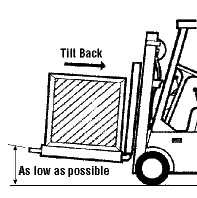
Back to top- Tilt loads backwards.
- Travel with forks as low as possible from the floor and tilted back (usually within 10-15 cm (4 to 6 inches) above the floor).
- Match speed to, load, presence of pedestrians, obstructions, and driving and workplace conditions, including slippery surfaces.
- Obey posted traffic signs and follow all traffic control requirements for that work location (e.g., driving on the right-hand side, lane markings, etc.).
- Decrease speed at all corners, sound the horn and watch the swing of both the rear of the lift truck and the load.
- Watch for pedestrians. Keep a safe distance from other lifting devices, pedestrians, elevated surfaces, ramp edges, machinery, etc.
- Avoid sudden stops.
- Travel in reverse when a load blocks your vision, and always look in the direction of travel.
- Match speed and driving to the load, obstructions, and workplace conditions, including slippery surfaces.
- Obey posted traffic signs and follow all traffic control requirements for that workplace (e.g., driving on the right-hand side, lane markings, etc.).
- Decrease speed around all corners, sound the horn, and consider the swing of both the rear of the forklift truck and the load.
- Watch for pedestrians. Keep a safe distance from other lifting devices, pedestrians, elevated surfaces, ramp edges, machinery, etc.
- Avoid sudden stops (for example, unsecured loads may fall off the forks).
- Travel in reverse when a load blocks your sight lines and always look in the direction of travel.
- Check for adequate overhead clearance when entering an area or raising the forks (including the load).
- Watch out for hazards while travelling, including oil spots, wet spots, loose objects, holes, rough surfaces, people, other vehicles, etc.
- Cross railroad tracks at designated track crossing locations only. Drive over the tracks at an angle.
- Maintain a safe working limit from all overhead power lines.
- Do not turn on ramps.
- Do not elevate the load when the forklift truck is on an incline.
- Do not allow riders, unless the forklift is designed to have a passenger seat or if an approved man-lift forklift cage is in use (man-lift workers must exit the cage each time the forklift must drive to a new location).
How should you steer to maintain control?
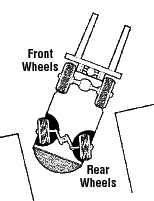
Back to top- Do not turn a lift truck steering wheel sharply at fast speeds.
- Do not overload a lift truck. It can cause a loss of steering control.
- Do not add extra weight to a counterweight to improve steering.
How do you maintain control when driving in reverse?
Back to top- Face the rear.
- Sound the horn before moving.
- Drive slowly.
- Stop when sight lines are limited or blocked.
- Use a signaller when needed.
How do you maintain control when travelling up or downhill?
Back to topAlways check with the manufacturer's operating instructions. In general:
- Loaded trucks, when travelling up and down a hill that is greater than a 5% grade should travel with the load pointed uphill.
- The unloaded truck should travel with the forks pointed downhill, regardless of the grade.
- Do not turn until on level ground whenever possible.
How should you shut down the forklift truck?
Back to top- Park in an approved location.
- Apply parking brakes.
- Lower the forks or load to the floor.
- Neutralize the lift controls. Set the direction lever in neutral and lock the mechanism (if present). Tilt the mast forward slightly and lower the forks to the floor until the fork tips touch the floor.
- Turn off the motor switch or turn off the controls.
- Remove the key.
- Shut off the fuel supply (e.g., disconnect the battery or go through propane shut-down procedures).
- Block the wheels if the truck is parked on an incline.
- Fact sheet last revised: 2023-09-27