Forklift Trucks - Fork Safety
On this page
How often should the forks of forklift trucks be inspected?
Back to topUnder normal operating conditions, forks should be inspected daily and every six months.
Daily: Operators should make visual inspection of forks during the pre-start-up check, giving special attention in looking for permanent distortions and cracks.
Six months: A thorough inspection of forks should be done every six months, preferably by a trained individual, to check for any cracks and distortion. Forks may need inspections more often, depending on the use of the equipment.
Check with your jurisdiction for any requirements regarding frequency of checks, and maintenance. A list of Canadian government departments responsible for health and safety can be found here.
What are some important points of a periodical (six months) fork inspection?
Back to top- Check fork blades for wear. Forks are constantly subjected to abrasion by concrete floors, steel shelving, etc. This abrasion can reduce the thickness of a fork until it cannot lift loads up to the designed capacity.
- Check for distortion. Fork blades can be bent out of shape. Depending on distortion, some forks can be straightened. The fork manufacturer is best qualified to correct this. Your local forklift supplier can make the arrangements.
- Check if forks are at different heights.
- Check for cracks in the heel or hanger. Cracks may appear on forks where attachments are welded on or in the inside radius of the bend area. Periodic inspection using a magnetic particle or dye penetrant test can detect cracks. Approved grinding methods may grind out and polish these blemishes, depending on the depth of the crack. Contact your forklift supplier or the manufacturer for additional information.
- Check fork angle. Forks should be manufactured with an angle of 90° (unless it is a fork designed for a special purpose).
- Replace, when necessary, with good quality forks. When ordering or reordering forks, make sure you are getting high quality forks that will do your lifting jobs safely. Insist on forged forks or ones with an upset heel.
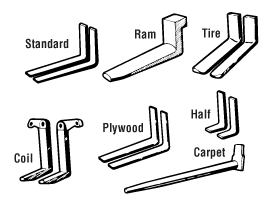
- Use the proper forks. Custom-designed forks may be needed for:
- unusual lifting conditions
- spark-free areas
- high heat furnace areas
- special object lifting
- Contact your forklift supplier for assistance.
What are some things you should not do to forklift forks?
Back to top- Do not overload the forks. Operators should be aware of the capacity of the forklift and the capacity of the forks. Overloading may bend and weaken forks.
- Do not repair your own forks. No one but the fork manufacturer should undertake the repair of forks.
- Do not modify forks without consulting with your forklift supplier.
- Do not use for anything other than their specified purpose.
- Fact sheet last revised: 2019-02-18