
Welding - Ergonomics
On this page
- What are ergonomic risk factors associated with welding?
- What are some tips for a good working posture while welding?
- What is an example of a standing workbench design?
- What is an example of a seated workbench design?
- What should I know before lifting cylinders manually?
- What should I know when moving cylinders?
- What should I know about lighting and colour?
What are ergonomic risk factors associated with welding?
Back to top- Lifting heavy loads (cylinders, cables, etc.).
- Awkward body postures (outreached arms, awkward position of neck and head, kneeling/squatting).
- Static body positioning (long duration of tasks, manual precision).
- Continuous force (grip strength).
What are some tips for a good working posture while welding?
Back to top- Learn to recognize symptoms of work-related musculoskeletal disorders (WMSDs; also called repetitive strain injuries or RSIs). Repeated uncomfortable postures and tasks can cause injury.
- Avoid awkward body positions which cause fatigue, reduce concentration and lead to poor welds which may need to be repeated.
- Always use your hand to lower your helmet. Do not use a "jerking" motion of your neck and head.
- Position yourself in a stable, comfortable posture.
- Position the welding item as flat as possible, on a horizontal surface, between waist and elbow height.
- Position stool or scaffolding at a comfortable height to allow working in a seated position.
- Avoid working in one position for long periods of time.
- Work with material slightly below elbow level when working in a sitting position.
- Work with material between waist and elbow heights for comfort and precision when working in a standing position.
- Use a foot rest if standing for long periods.
- Always store materials and tools within normal reach.
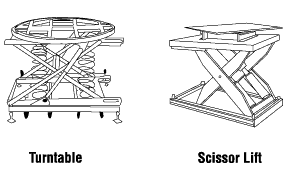
- Use positioning aids to accommodate work posture.
What is an example of a standing workbench design?
Back to top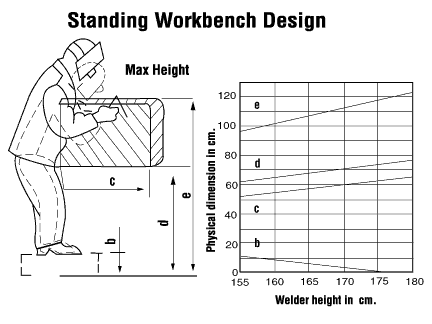
What is an example of a seated workbench design?
Back to top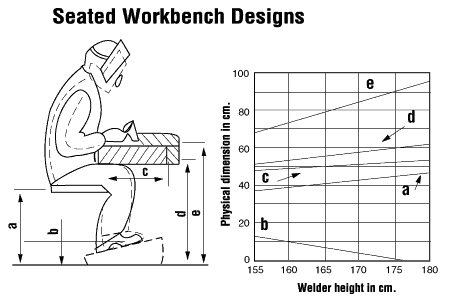
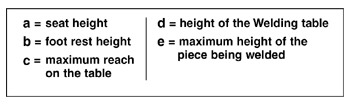
Source: Golavatjuk et.al. creation of optimum labour conditions for electric welders with regard to ergonomic requirements. IIW Calloquium on Welding and Health, Lisboa (1980)
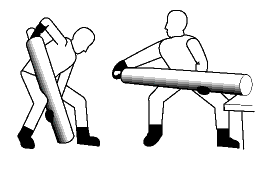
What should I know before lifting cylinders manually?
Back to top- Find out the weight of an object before attempting to lift it.
- DO NOT lift full or partially full cylinders on your own.
- Use a lifting aid if the object is heavy.
- Use a trolley or a mechanical lift to lift or move compressed gas cylinders.
- Get help with heavy or awkward loads if a lifting aid is not available.
- Do a few warm up stretches before lifting.
- Protect hands and feet in case the load falls.
- Place forward foot around the cylinder if it must be lifted manually.
- Lower the cylinder across thigh by pressing down with rear hand while holding cylinder underneath and slightly beyond center point.
- Raise end to desired height.
- Push cylinder forward by rear hand.
What should I know when moving cylinders?
Back to top- Make sure the cylinder cap is secured.
- Tilt the cylinder slightly on its edge and roll it slowly in the direction desired. Move short distances only.
- Use a cylinder trolley for longer distances.
- Place one hand on top of the cap and the other hand on the shoulder of the cylinder.
- Always chain the cylinder to the trolley.
What should I know about lighting and colour?
Back to topLighting
- Ensure general lighting is adequate to allow safe access and handling of equipment.
- Use additional task lighting for precision work.
- Avoid excessive glare from light sources or reflections.
- Prevent excessive contrast between the workpiece and background.
Colour
- Select matte finishes for welding area to avoid reflection of welding arc light, and to obtain a satisfactory level of lighting.
- Choose any colour except blue or turquoise; they reflect UV light.
- Reduce distraction by making piping, ducting or structural supports the same colour as the background, unless piping requires a second colour coding.
- Fact sheet last revised: 2017-09-12